The School of Night may be Knausgaard’s most accessible, suspenseful, and intriguing novel so far. Whether it’s his “best,” or maybe even a “perfect” novel, despite being the fourth in The Morning Star series, it feels complete on its own, unlike any of his novels since A Time for Everything, and therefore it may be the place to start if you’re KOK curious.

Perfect Backstory Novel Within the Possible “Star Structure” of the Series
My review of The Third Realm presents the possible pentacle-like “star structure” of the series, with interior “meeting place” novels set more or less in the present, populated by a handful of first-person narrators (The Morning Star, The Third Realm, and most likely three others to come) and exterior “peripheral” backstory novels mostly set in the past (The Wolves of Eternity, The School of Night, Arendal, and most likely SEVEN others to come, if the author ultimately fulfills the totally ambitious structure he’s suggested).
The School of Night is really the first of the exterior/peripheral novels (along the sides of the star shape) after the revelation of the structure by “the star architect” in the third section of the third novel to successfully show how the structure works. I’m not sure Knausgaard understood what he was doing, structure-wise, when he wrote The Wolves of Eternity, which is comparatively messy and not really something that can stand alone, or if read out of context of the series it would confound more than satisfy? But The School of Night shows how these backstory novels in the series can operate with great latitude, free from the central story of the interior novels and the present-day supernatural intrigue yet charged by the possibility of a second sun suddenly appearing in the sky or of a character who dies possibly not quite actually dying at all or returning somehow.

A Devil’s Bargain Novel
The School of Night is a Faustian pact novel. The somewhat overblown, certainly misleading, and potentially AI-generated jacket/flap copy suggests a literal deal with the devil in the guise of an artist from the Netherlands named Hans who Kristian meets in a London bar, but Knausgaard is a better writer than that. Instead of offering a straightforward “cautionary tale” on “moral depravity,” he applies plentiful layers of ambiguity. By the end of the novel it’s clear that total fulfillment of Kristian’s artistic ambitions has involved a variety of deal with the devil but when exactly did that deal go down? Possibly when something happened with his sister and he really only thought about himself and his art? Or before that, when he decided to be true to his own nature, to put all his chips in on his artistic self? By the time he meets Hans and is introduced to the director of a staging of Faust, it’s already too late for him, isn’t it? Or maybe when he took the trash bag filled with photos from Hans’s old loft and left behind a special little gift of his own?
The book excels at ambiguity of this sort, very much in large part because it’s also so clear sentence to sentence, page to page. And this ambiguity extends to what some readers call “likability,” the question of whether or not one should root for Kristian as he pursues ends via questionable means, or even more so the fundamental scene of the novel after he generously bestows upon an old decrepit homeless man two cigarettes and a light.
The School of Night also presents and in part rhymes with possible dynamics between Shakespeare and Christopher Marlowe (the author of Doctor Faustus), who was part of a group of atheists known as The School of Night — why the translation is titled as such instead of “The Night School” as expected.
Künstlerroman
If Wolves was in part about a man whose life is committed to death (ie, a mortician) learning to pay attention to life, The School of Night is narrated by a noticer, a young man with eyes wide-open to art and music and physical beauty. But Kristian, the 20-year-old Norwegian narrator studying photography at an art school in London in the mid-’80s, isn’t an innocent despite inexperience. He senses his capabilities and believes in his potential despite not yet having produced much of merit. And wanting to create something great — or at least interesting, unexpected, beguiling, radiating whatever qualities he sees in what he deems admirable art — drives him in part to essentially cut off contact with his family and even take on a different surname after, while home for Christmas, he overhears his father demean him during a fraught time for the family.
(Christmas Knausgaard is flat-out wonderfully fun reading FWIW, and as far as I can remember not something yet to appear in one of his novels, complete with an outing in the snow on a sleigh to find and cut down a Christmas tree. But it’s not all joyous juletid thanks to Kristian’s søster.)
The School of Night is a Künstlerroman showing the development and maturation of a stjernefotograf (a “star photographer” instead of a star architect as in The Third Realm). Just as he associatively orders his records, one area of exploration intuitively leads to another. A focus on structure (the intricate architecture of trees, beams and girders of building’s under construction) leads to the darkly comical process by which he creates his breakthrough image. All of which is interesting and good, thematic jetsam that flows downstream with ease and at pace thanks to a few instances of super-satisfying extended suspense, the first major narrative propulsion benefiting from literary precedence, echoing Raskolnikov, and then the rocket boost propelling the final third or so of the novel comes with contemporary relevance related to so-called cancel culture, echoing the 2022 movie Tár. These larger sections of suspense in turn are driven by smaller, simpler, yet sufficiently suspenseful sections relevant to anyone: will Kristian and his normie downstairs neighbor hook up, and will something bad happen toward the end to the boy?
Whenever a young child is potentially endangered, at least since I became a father twelve years ago, I’ve had massive trouble for example when children are endangered. I issue all-caps accusations of EMOTIONAL MANIPULATION. But Knausgaard, the father of innumerable children at this point (the acknowledgments at the end list a Brady Bunchian number of names) handles all this perfectly well, knowing how lightly he needs to introduce the endangerment among Kristian’s progression through the day with his child. I won’t reveal too much about all this, just that it’s emotionally stirring, absolutely lucid, engaging, page-turning, satisfying reading that seems totally “earned,” as they say in creative writing classes.
Abschiedsbriefroman?
The School of Night is also a suicide-note novel, something that only clarified for me once I re-read the opening pages (which I had first read eight months earlier) after the book’s perfectly satisfying ending, inevitable in its way since it suggests Marlowe’s death as well. But — spoiler — of course Kristian doesn’t dramatize his own death, it’s left open, and knowing what we know of the series overall, it’s very possible that death is not the end. (Apparently, per something I just read on Reddit, Kristian appears as a corpse in The Morning Star and The Third Realm but I didn’t catch this connection.)
A frame device introduces the suicide note motif, set in a cabin on the water in Norway, a setting that briefly appears three times, but the novel mostly takes place in London and Kristian’s family home in Norway in the mid-1980s, and Manhattan and London again in approximately 2010? The latter section in New York I loved, if just for Knausgaard/Kristian’s descriptions of the city. The bit on the screenshot below surprised and “resonated” — I laughed aloud and posted the image as an IG story seen by maybe two dozen friends, although I do like Lou Reed, The Talking Heads, and Television (and I’m learning to like Patti Smith, listening to Just Kids now and really enjoyin’ it). (Note: the autotranslation thing on Kindle often detected and translated from Danish, which is very similar to Norwegian.)

In Sum
Overall, I’d say there’s something about this one that feels almost perfect in its conception, structure, and execution, including loose ends that open spaces of possibility (for example the friend from Norway who visits or the guy who seemed to be following Kristian around London), almost like storyline nubbins that could be picked up and developed in future volumes or remain as they are, red herrings to enhance the sense that the novel’s reality, despite the supernatural superstructure, pledges allegiance in its details to the natural looseness of life.
*
I Reserve the Right to be Wrong About the Star Structure However

I just learned of the existence of Jeg Var Lenge Død — I Was Long Dead — scheduled to publish in October 2025 in Norway — seems like it’s about Syvert’s brother, Joar, and takes place in the present era when the star appears. Per my pet theory pentacle structure paradigm, it’s an “interior” novel, I suppose, although since it apparently has a single narrator it’s not a “meeting-place novel,” so maybe the “interior” novels are primarily marked by a contemporary time frame more than the number of narrators? Or maybe Jeg Var Lenge Død intentionally blends the interior- and exterior-type distinction since it apparently involves exploration of the afterworld, that is, a place where distinctions such as past and present, living and dead, are transcended?
Betelgeuse Supernova?
I wonder if Knausgaard got the idea for The Morning Star series from articles on the likelihood of Betelgeuse, one of the shoulders of the constellation Orion, apparently going supernova fairly soon (within 10K years). If this happens during our lives, Knausgaard will seem prophetic for sure. As with DeLillo’s Mao II, something about novel writing sometimes glimpses the future. The first volume of the series was published in 2020, right around the time Betelgeuse started dimming, possibly in advance of an explosion. Anyway, something to think about and the likely culprit if you suddenly see what looks like another sun in the sky.
Where to start with Knausgaard at this point?
If you’re trying to figure out which of his many books to read first, do you start with six volumes of My Struggle? Four volumes of The Seasons Quartet? Two early standalone novels (only one available in English so far), an essay collection, a book on Munch, a book about soccer written with another writer, and a few others? Not to mention six volumes so far of the Morning Star series: The Morning Star, The Wolves of Eternity, The Third Realm, The School of Night, Arendal, and I Was Long Dead those last three unavailable at this point in English?
Seems weird to suggest starting with the fourth novel in a series, but if you’ve never read Knausgaard, this may be the place to start — or a recommended reentry point if you’ve only read My Struggle 1 and maybe 2. You don’t need to have read the first three in the series, although knowing the themes and expectations of the others would definitely thicken and extend (engorge?) your reading experience.
The Below Relates More to My Reading Experience (What I Call “Words Without Friends”) Than to the Book Itself
My reading experience was engorged by the eggplant of novelty. Unlike every other novel I’ve ever read (other than a short Tomas Espedal book earlier this year), I read the original Norwegian/Bokmål edition of Nattskolen in ebook format (consistently referring to the automatically generated English translation via Kindle to confirm my understanding after I read a third of a page). Also, unlike every novel I’ve ever read, I read Nattskolen over the course of eight months, from January to August 2025, at first trying to cover a single ebook page a day and then aiming to accomplish the reasonably achievable goal of a single ebook percentage per day (1% of ~584 pages was about six or seven pages).

Over the months of making my way through the ebook, my reading speed and comprehension improved as I looked up words multiple times until I finally knew what they meant without necessarily translating them. Uforvarende simply meant uforvarende, for example. Notably, I learned the word faen in this, which for some reason didn’t come up in the Duolingo course I completed, and which the translation feature sometimes refused to translate, at most offering “damn.” And generally after a while I didn’t feel like I was dealing with a “foreign” language. Toward the end I felt comfortable with the process of reading a language that a few years ago would have been daunting/impossible, and I just downloaded Arendal, the fifth volume in the series, to ensure that the progress I’ve made in the language doesn’t degrade. (And I just learned of the existence of I Was Long Dead.)
Over the past few years, achieving a degree of reading facility in Norwegian and French, and this year in Italian, I’ve come to realize that I enjoy settling or at least mapping in my mind a territory that at first seems disorientating and wild. In the modern era, I first noticed this about 10 years ago when I rediscovered electric guitar and started exploring the endless world of effect pedals (see Neutral Evil ))) ), and again six years ago when we moved from the South Philadelphia city grid to the wild winding hills 15 miles west of Philly (see Chaotic Good). Streets in the new area aren’t numbered, their undulations determined by topographical irregularities, creeks, ravines, really old trees. It felt like a maze at first, and I loved not quite knowing where I was, that feeling of being turned around. But now I drive without really even thinking about how to get where I’m going. I enjoyed that process of learning our new area, just as I enjoy encountering a page of incomprehensible text and over time making sense of it, if not totally settling it. To put it simply: I’ve realized fairly recently that I really like learning.
But sometimes I wonder why I intuitively decided to learn Norwegian when first presented the options on Duolingo? At first I intended to “do” German or French (my Spanish is already pretty good) but then seeing that they offered Norwegian, because I’d read so much Hamsun, Knausgaard, Solstad, Vesaas, Bjornboe, Espedal, et al, I tried Norwegian and figured it would be easier than German or French for a native English speaker. I definitely didn’t intentionally decide to learn Norwegian just to get a jump on reviewers who have to wait to receive Advanced Reading Copies of Knausgaard’s new novels in translation.
And I definitely look forward to reading the official English translation by Martin Aitken in part to revisit this world: mid-’80s art school in London soundtracked by post-punk on vinyl (I made a playlist of more or less everything Kristian mentions or puts on his turntable — loved seeing that he listened to The Fall and Neu), a Christmas break in scenic snowy Norway, relatively contemporary NYC, and back to London and then a cabin on the fjords in sunny nocturnal Norway.
I’ll surely update this page once I read the English translation in 2026 (will probably finish Arendal and read Jeg Var Lenge Død before returning to The School of Night).
And in late-April 2026 I returned to The School of Night in English after reading those two, per the plan in the previous sentence, but after a few pages I figured I’d wait to read the English translation until the fall, when the weather turns dark and gloomy — it’s not an April novel, really.
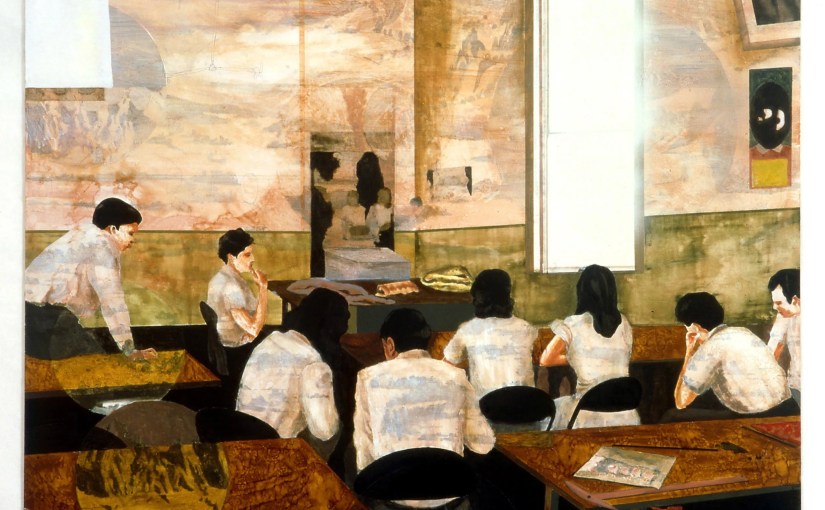
Note: the image at the top of the screen is a painting by Mamma Andersson, whose work is on the cover of the Norwegian edition of Nattskolen and The School of Night.
*
Fulfill all your Knausgaard needs with the following posts:
I Was Long Dead by Karl Ove Knausgaard: The Wild Other Side of the Speed of Light
Arendal by Karl Ove Knausgaard: Deep Cut for a Cold Dark Night
The Wolves of Eternity by Karl Ove Knausgaard: Prequel to an Infinite Arc
The Seasons Quartet by Karl Ove Knausgaard
The Complete My Struggle Series by Karl Ove Knausgaard
Angels & Demons at Play: A Time for Everything by Karl Ove Knausgaard
October Child by Linda Boström Knausgaard, translated by Saskia Vogel (scroll about a quarter of the way down the page)
+
To support the publishers who have supported my writing, please acquire a copy of Like It Matters, Chaotic Good, Neutral Evil ))), and/or JRZDVLZ (all from Sagging Meniscus). Or my translation of Horacio Castellanos Moya’s Revulsion: Thomas Bernhard in San Salvador (from New Directions). Or Thanks + Sorry + Good Luck: Rejection Letters From the Eyeshot Outbox (from Barrelhouse). Or The Shimmering Go-Between from me (Atticus, the publisher, is kaput).